Job searching has changed… for good!
A few years ago, finding a job meant applying to listings and waiting. Today, candidates are using AI to write resumes, prepare for interviews, identify companies, and even plan their careers.
The advantage is no longer access to opportunities. The advantage is how well you use the tools available to you.
In 2026, AI will not replace job seekers but job seekers who use AI effectively will outperform those who do not.
This guide breaks down how to use AI tools in a practical way to find jobs faster and grow your career.
1. Use AI to Build Smarter Resumes (Not Just Faster Ones)
Most people use AI to generate resumes quickly. That is not a wrong approach but not the ideal one as well. A resume should not just exist, it should match the job applied for.What to do:
Instead of asking AI to “create a resume,” do this:
- Paste the job description into ChatGPT
- Add your current resume
- Use the prompt:
“Rewrite my resume to match this role with measurable impact and relevant keywords”
The goal is to focus on:
- Results and deliverables, not just tasks
- Numbers, not vague statements
- Relevance to the role, not fluff
Tools you can use:
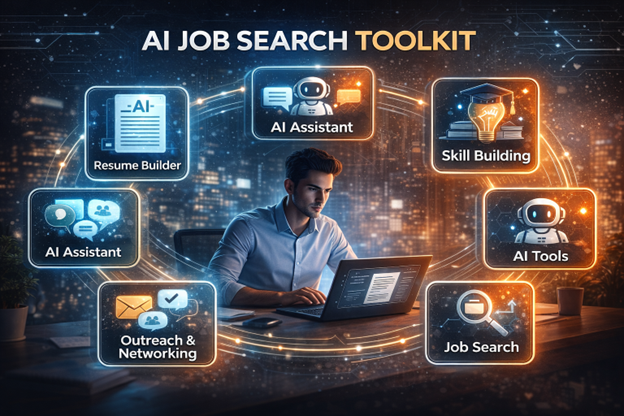
2. Use AI to Discover Jobs Beyond Job Portals
Most candidates rely only on job portals to find jobs. That limits visibility because many opportunities are never posted publicly or get filled quickly.
What to do:
Use AI to identify companies instead of just roles.
Try prompts like:
- “List companies hiring for data analysts in New Jersey”
- “Which startups are expanding in fintech hiring”
Then:
- Visit company career pages
- Reach out directly
- Track openings early
Tools you can use
3. Use AI to Write Better Applications and Messages
Most applications fail because they sound the same, too generic, too robotic. AI helps you stand out, but only if you guide it properly.
What to do
Use AI to:
- Write tailored cover letters
- Draft recruiter messages
- Refine your tone
Example prompt:
“Write a short and professional message to a recruiter for a business analyst role, highlighting my experience in data and process improvement.”
Then edit it to sound like you. Make sure you do this. Your voice is important to enhance what AI has written.
Tools
4. Use AI for Interview Preparation
This is where AI creates real advantage.
Most candidates prepare by reading questions, but better candidates simulate conversations.
What to do
- Ask AI to act as an interviewer
- Practice answers out loud
- Request feedback on clarity and structure
Example:
“Act as an interviewer for a product manager role and evaluate my answers.”
This builds confidence and improves delivery.
Tools
5. Use AI to Build Skills Faster
Career growth depends on learning speed.
AI helps you:
- Break down complex topics
- Create structured learning plans
- Apply knowledge quickly
What to do
Ask:
“Create a 30-day plan to learn Excel for business analysis with practical exercises.”
Then follow it consistently.
Tools
6. What Most People Get Wrong About AI in Job Search
AI is powerful but half used or even misused.
Common mistakes people make:
- Copying AI output without editing
- Using the same resume for every job
- Relying only on tools, not strategy
- Ignoring networking
AI should improve your thinking, not replace it.
7. The Real Advantage in 2026
In 2026, the difference will not be who uses AI, It will be how they use it.
The candidates who succeed will:
- Adapt quickly
- Communicate clearly
- Learn continuously
AI simply helps them do this faster.
Final Thoughts
Job searching is no longer about applying more.
It is about:
- Applying smarter
- Positioning yourself better
- Improving faster than others
AI gives you leverage but direction and vision still comes from you.
Use it well, and you will not just find a job faster but you will also build a stronger career.